How I picked these
Definitions follow the federal standards of identity. The bottle examples are ones from my own shelf, chosen because each shows one designation clearly.
Updated Sep 16, 2026
When people ask me about the "types" of bourbon, they usually mean the words printed on the front of the bottle. Straight. Bonded. Single Barrel. Small Batch. Barrel Proof. These aren't flavor categories. They're legal designations (mostly) that tell you how the bourbon was made, how it was bottled, and what guarantees come with the label.
Some of them are meaningful quality signals. One of them is pure marketing. Knowing the difference is the single biggest upgrade you can make to how you shop for bourbon.
This guide walks through every designation you'll see on the shelf, what each one actually means under federal law, and which bottles I'd put in your cart for each category. If you want the broader "what is bourbon" question answered first, start here.
Straight Bourbon: the foundation
If you take one thing from this article, take this: most quality bourbon on the shelf is Straight Bourbon, and that word "Straight" is doing more work than people realize.
To put "Straight Bourbon" on the label, the whiskey has to meet the standard bourbon rules (51% corn minimum, new charred oak, distilled below 160 proof, etc.) AND two additional requirements:
- Aged for at least two years
- If aged under four years, the exact age must be stated on the label
That second rule is the quiet hero. It means any bottle of Straight Bourbon without an age statement is by default at least four years old. No tricks, no "natural flavors," no caramel coloring. Just whiskey that's been in a barrel long enough to taste like bourbon.
Most of the famous brands you know are Straight Bourbon: Buffalo Trace, Wild Turkey 101, Maker's Mark, Woodford Reserve, Four Roses, Knob Creek. If a bottle doesn't say "Straight" on it, look closer. It may be a blended bourbon, a bourbon under two years old, or something that doesn't meet the additional requirements.
Why "Straight" matters more than people think
The no-additives rule is the cleanest single quality signal in American whiskey. Scotch can legally add caramel coloring. Many Irish whiskeys do the same. Straight Bourbon can't. What's in the glass is grain, water, yeast, oak, and time.
That's why I almost never recommend a bourbon that isn't Straight. The exceptions are vanishingly rare, and you don't need them.
Bottled-in-Bond: the value sweet spot
This is the designation I push hardest on people just getting serious about bourbon. The Bottled-in-Bond Act of 1897 was the first U.S. consumer protection law for food and drink, and the rules it set haven't changed much in 128 years.
To carry "Bottled-in-Bond" or "Bonded" on the label, the bourbon must be:
- The product of one distillery
- From one distilling season (January-June or July-December)
- From one distiller
- Aged at least four years in a federally bonded warehouse
- Bottled at exactly 100 proof
No blending across distilleries. No mixing seasons. No proof variation. Bonded bourbon is the most transparent designation in the category, and it almost always punches above its price.
Heaven Hill Bottled-in-Bond
Seven years old, 100 proof, single distillery, single season. Heaven Hill resurrected the Heaven Hill brand name in 2019 as a Bonded expression and it's been one of the best dollar-for-dollar bourbons on the shelf ever since. Caramel, oak, a touch of cinnamon, and a long warming finish. There is not a better bourbon at this price.
Other Bonded bottles worth knowing: Old Forester 1897 (the original Bonded brand, around $50), Wilderness Trail BiB (craft-distilled, around $65), and Henry McKenna 10 Year BiB (which is also a Single Barrel, covered below).
Single Barrel: one barrel, no blending
Most bourbon on the shelf is a blend. Not blended whiskey in the legal sense — that's a different category — but a blend of many barrels mingled together to produce a consistent flavor profile across every bottle of a given brand. Maker's Mark, Buffalo Trace, Woodford Reserve: all blended from dozens or hundreds of barrels per batch.
Single Barrel bourbon comes from exactly one barrel. The flavor profile varies bottle to bottle, batch to batch, sometimes dramatically. That's the appeal. Two bottles of the same Single Barrel brand can taste noticeably different depending on which warehouse the barrel sat in, what floor it was on, and how the seasons treated it.
Four Roses Single Barrel
One of the most reliably excellent bourbons I keep on my shelf at all times. Four Roses uses 10 different recipes (combinations of two mashbills and five yeasts), and the standard Single Barrel is the OBSV recipe: high-rye mashbill, delicate fruity yeast. The result is layered, spicy, and complex. Caramel and pear up front, baking spice and oak in the back.
Blanton's Original Single Barrel
The bourbon that arguably created the modern Single Barrel category back in 1984. Distilled by Buffalo Trace, bottled at 93 proof, with the iconic stoppered bottle and horse-and-jockey caps that collectors chase one letter at a time. Honey, citrus, vanilla, and a clean finish.
Honorable mention: Henry McKenna 10 Year is both a Single Barrel AND a Bottled-in-Bond expression, which is rare. It runs around $40-50 and delivers stunning value when you can find it.
Small Batch: the marketing term
Here's the hard truth: "Small Batch" has no legal definition. None. A distillery can blend 10 barrels and call it Small Batch. They can also blend 200 barrels and call it Small Batch. The TTB doesn't regulate the term.
That doesn't mean every Small Batch bourbon is dishonest. It means the words "Small Batch" on a label tell you nothing about the actual size of the batch.
So how do you read it? Treat "Small Batch" as a tier label within a specific brand's lineup, not as an objective quality signal. Knob Creek Small Batch, Four Roses Small Batch, and Maker's Mark 46 are all "Small Batch" by their distillery's internal standards, and they're all very good. But the words themselves don't guarantee anything.
Small Batch tells you what the marketing department wants to communicate. Straight Bourbon and Bottled-in-Bond tell you what the federal government will hold the distillery to.
When you see "Small Batch" on a label, look for what else is on it. If it also says "Straight" and has an age statement, you're in good hands. If "Small Batch" is the only modifier, take it with a grain of salt.
Barrel Proof and Cask Strength: undiluted bourbon
Most bourbon you buy has been cut with water to a standard bottling proof, usually 80 to 100. Barrel Proof bourbon skips that step. What's in the bottle is what came out of the barrel, often running 110 to 130+ proof depending on the expression.
"Cask Strength" means the same thing. The terms are used interchangeably, though "Barrel Proof" is more common on American whiskey and "Cask Strength" shows up more on Scotch.
There's no specific legal definition for "Barrel Proof" the way there is for Bonded or Straight, but the TTB does require that anything labeled Barrel Proof must be within 2 degrees proof of what came out of the barrel. So it's not pure marketing — there's a meaningful guarantee behind the term.
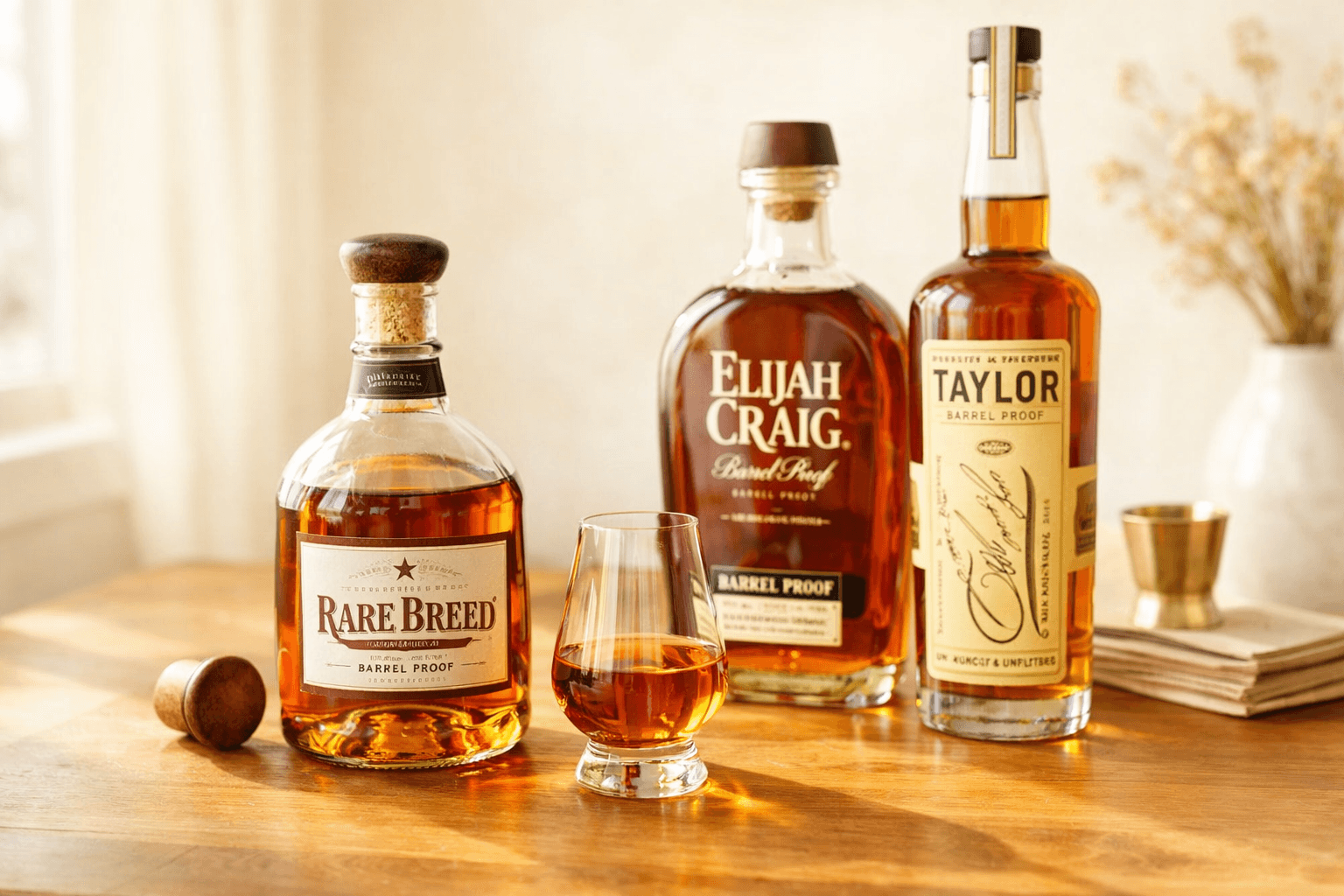
Elijah Craig Barrel Proof
Released three times a year in batches (look for the letter-number code like B523 or C924). Each batch varies slightly in proof and flavor, but the quality is reliably high. Expect rich caramel, dark fruit, significant oak, and a finish that lasts. One of the most consistent barrel proof bourbons on the shelf.
Wild Turkey Rare Breed
The most approachable barrel proof bourbon on the market, and the one I recommend as a first entry into the category. Bottled around 116 proof, with the classic Wild Turkey profile: vanilla, caramel, baking spice, and toasted oak. No allocation, no chasing. It's just on the shelf.
We have a dedicated guide to the best bourbons in this category — including the harder-to-find Stagg and EH Taylor Barrel Proof releases. Read the full Barrel Proof guide here.
Uncut and Unfiltered: the related designations
You'll often see "Uncut" or "Non-Chill Filtered" on bourbon labels, and they're worth knowing.
Uncut is synonymous with Barrel Proof. Same meaning, different word.
Non-Chill Filtered (or "Unfiltered") is a separate process. Most bourbon is chilled to near freezing and filtered to remove fatty acid compounds that can cause a slight haze in cold conditions. Non-chill filtered bourbons skip this step. The argument is that chill filtration also strips out some of the flavor compounds, so leaving them in produces a richer, more textured pour.
In practice, the difference is subtle. You'll notice it most with high-proof bourbons where the oily mouthfeel is part of the experience. Wild Turkey Rare Breed, Elijah Craig Barrel Proof, and most craft barrel proof releases are non-chill filtered. If you see the term on a label, it's a small positive signal but not a decisive one.
A quick word on mashbill (the other way people slice this)
Some guides organize bourbon by mashbill rather than by label designation: wheated, high-rye, traditional, four-grain. That's a useful frame for predicting flavor, but it's not what's printed on the bottle.
Quick reference if you want to think about bourbon this way too:
- Wheated bourbons use wheat as the secondary grain instead of rye. Softer, sweeter, more caramel-forward. Maker's Mark, Weller, Larceny, Old Fitzgerald.
- High-rye bourbons use more rye in the mashbill (usually 20%+). Spicier, bolder, more aggressive. Four Roses, Bulleit, Old Grand-Dad, Basil Hayden's.
- Traditional bourbons sit in the middle (70-78% corn, 8-15% rye). The classic profile. Buffalo Trace, Wild Turkey, Jim Beam.
- Four-grain bourbons use wheat AND rye. Layered and complex. Woodford Reserve Four Grain, High West, some Four Roses recipes.
If you want to go deeper on high-rye specifically, we have a full guide including the best bottles in that style. And if the spice in those bottles is what you're after, straight rye takes it further — our guide to the best straight rye whiskey ranks the bottles worth buying.
Types of bourbon glasses
Quick note on glassware, since this comes up in the same conversation often enough.
The three glasses worth owning are the Glencairn (tulip-shaped, concentrates aromatics, best for neat sipping), the rocks glass (also called an Old Fashioned glass, best for cocktails and ice), and the copita or NEAT glass (for serious tasting and proofing sessions). You don't need anything fancier than that.
If you're building your home setup, we cover the full lineup in our Best Bourbon Glasses guide, including specific brand picks and what to avoid.
Where to actually start
Here's how I'd sequence this if you're just getting into bourbon and want to learn by tasting:
- Start with a Bottled-in-Bond. Heaven Hill BiB or Old Forester 1897. You'll understand what 100 proof and four-year aging do to the flavor.
- Add a Single Barrel. Four Roses Single Barrel is the easiest call. Compare it side by side with your Bonded bottle and notice how much more layered it is.
- Try a Barrel Proof. Wild Turkey Rare Breed. Add a few drops of water. Let it open up.
- Then pick a mashbill style you like. Wheated, high-rye, traditional. By this point your palate will tell you where to go.
That four-bottle sequence covers every meaningful designation on the shelf and costs around $150 total. It's the most efficient way to learn what each of these terms actually means in the glass, instead of just on paper.
Most importantly: ignore "Small Batch" as a quality signal. Read what's actually on the label. The federal regulations do the work for you if you know which words to look for.